

Modern computer systems are designed with this purpose in mind so that they can easily handle huge amounts of work with multitasking and very complex applications, and that is the reason they are designed in this way. In order to obtain greater performance and efficiency, computers can be designed in such a way that multiple processors can be used instead of relying on a single CPU. For this complex purpose, one such popular system is SMP.
If you are still thinking about what is SMP, how it works, and why it is important in modern computers, then here is the detailed guide that will explain everything to you in a simple and easy way.
Understanding What Is SMP
SMP (Symmetric Multi-Processing) is a computer architecture where two, three, or more identical processors are working together and are using the same operating system and only one common main memory.
No matter the number of processors in the system, they are all treated equally and are the reason all the processors in the system can do the same jobs.
In any computer system, there are cases where one processor controls the other processors in the system. But in the SMP system, any processor in the system can work independently. Moreover, the processor can cooperate easily with the other processors in the system.
SMP can be understood in simple terms as many CPUs working together in the same system so that the tasks in the system are done faster.
It can be understood more easily as a team working on a project. If only one person in the team does all the work in the project, it will take more time. But when many people in the team are working together at the same time, the tasks are done faster.
Diagram: Basic Structure of an SMP System
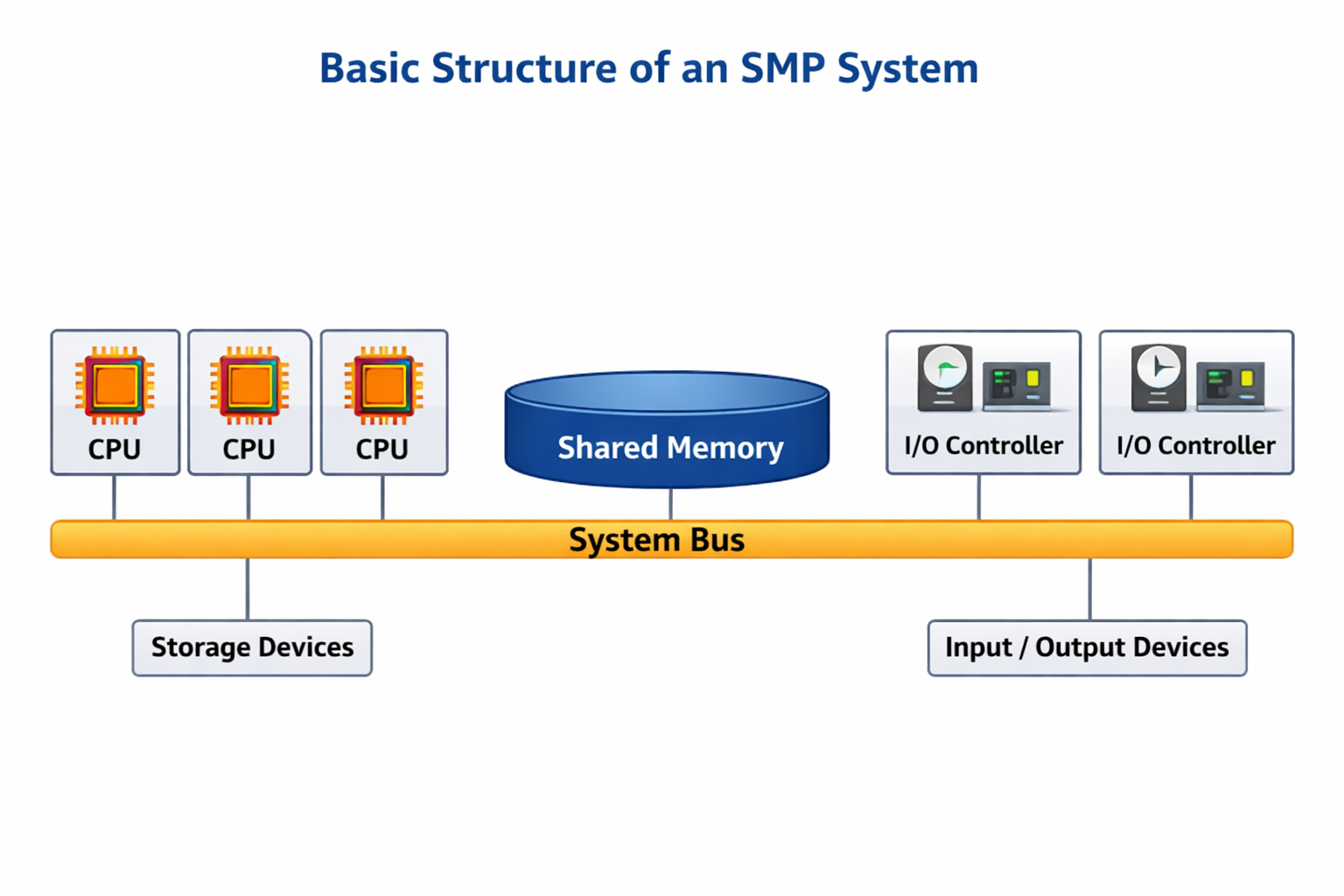
This diagram shows that multiple processors connect to the same memory and I/O devices, which allows them to work together efficiently.
How SMP Works
To fully understand what is SMP, it’s important to know how it operates internally.
In an SMP system:
Multiple processors are connected to the same shared main memory.
All processors use the same operating system.
The operating system distributes tasks among processors.
Each processor can execute processes independently.
When a task arrives, the operating system decides which processor should handle it. If multiple tasks are running, they are distributed among the available processors.
For example, if a system has four processors, the workload can be divided so that each processor handles a portion of the tasks at the same time. This results in faster execution and better performance.
Diagram: Task Distribution in SMP
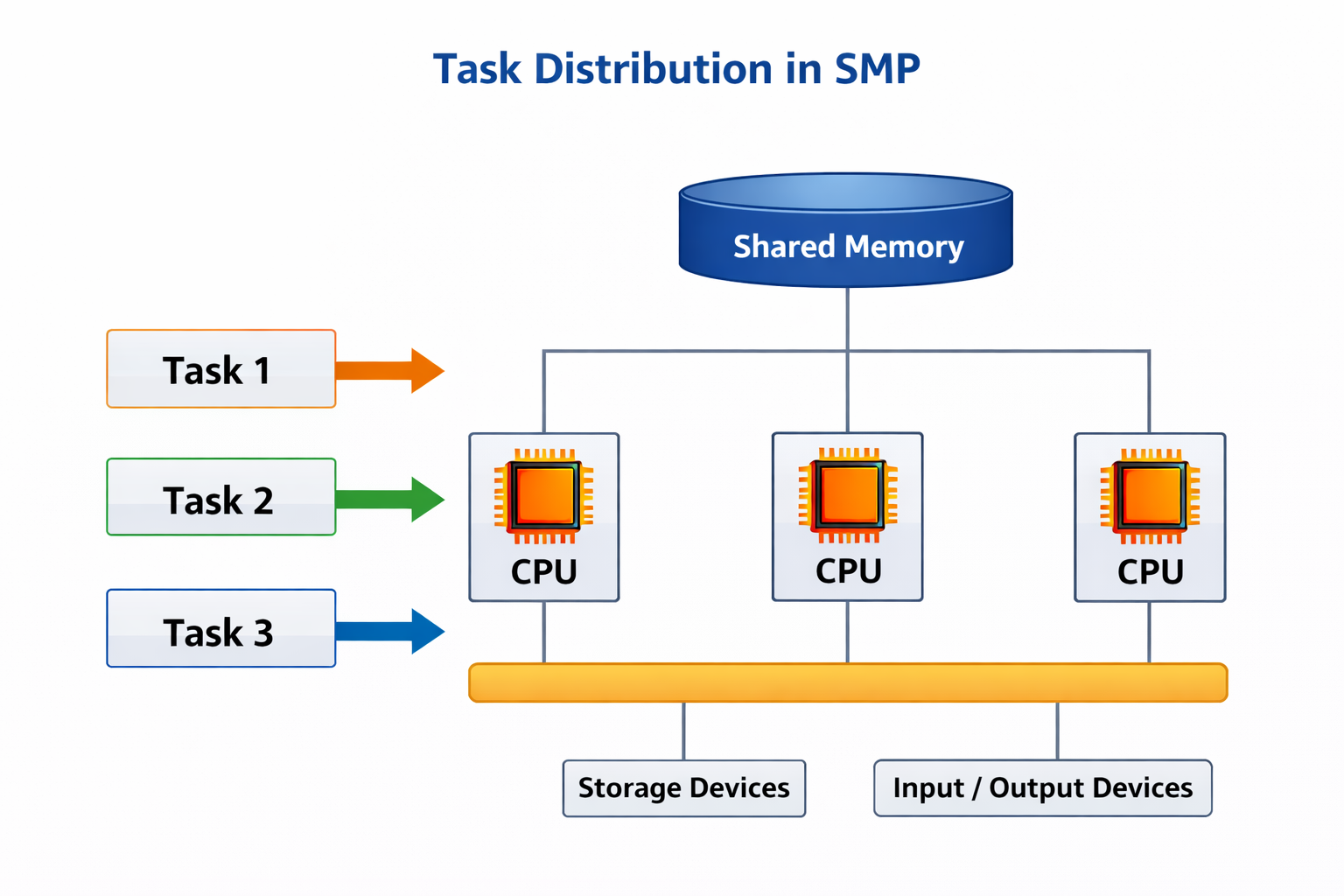
The operating system acts like a manager, assigning different tasks to different processors.
Key Characteristics of SMP
There are several features that define an SMP system.
Identical Processors
One of the most important characteristics of SMP is that all processors are identical. This means each processor has the same capability and performance level.
No processor acts as a master or controller. Every processor has equal responsibility in executing tasks.
Shared Memory
All processors in an SMP system share a single main memory. Because of this shared memory, processors can easily access the same data.
This feature also allows processors to communicate with each other quickly.
Shared Input and Output Devices
Processors in SMP systems can also access the same input and output devices, such as storage drives, printers, and network interfaces.
This ensures that all processors can perform operations involving data input and output without restrictions.
Parallel Processing
SMP supports parallel processing, meaning multiple operations can occur simultaneously.
For example:
- One processor might handle system processes
- Another processor might run applications
- Another processor might manage background tasks
This parallel execution significantly improves system performance.
Diagram: Parallel Processing in SMP
Each processor executes a different task simultaneously, which speeds up the overall computing process.
Applications of SMP
Understanding what is SMP becomes easier when we see where it is used in real-world systems.
Servers and Data Centers
Many enterprise servers use SMP architecture to handle large workloads.
Servers often need to process thousands of requests at the same time, and SMP allows them to distribute this workload across multiple processors.
Parallel Computing
SMP systems are widely used in parallel computing environments, where large problems are divided into smaller tasks.
Examples include:
- Scientific simulations
- Weather forecasting
- Large data analysis
These tasks require significant computing power, which SMP systems can provide.
Time-Sharing Systems
Time-sharing systems allow multiple users to use the same computer simultaneously.
SMP improves the efficiency of these systems by assigning different user processes to different processors.
Multithreaded Applications
Many modern software applications use multithreading, where multiple threads run at the same time.
SMP systems are ideal for multithreaded applications because each processor can execute a different thread simultaneously.
Examples include:
- Video editing software
- 3D rendering tools
- Modern web servers
Diagram: SMP vs Single Processor System
This comparison clearly shows how SMP allows multiple tasks to run simultaneously, while a single processor must handle tasks one at a time.
Advantages of SMP
There are several reasons why SMP architecture is widely used in modern computing systems.
Higher Throughput
Throughput refers to the number of tasks a system can complete within a certain time period.
Because multiple processors work together in SMP, more tasks can be completed in less time.
Better Performance
SMP systems can handle heavy workloads more efficiently. When many programs are running simultaneously, the system distributes the tasks across processors to maintain smooth performance.
Improved Reliability
If one processor fails in an SMP system, the entire system does not stop working. The remaining processors continue executing tasks.
This improves the reliability of the system.
Efficient Resource Utilization
Since all processors share the same memory and devices, system resources are used more efficiently.
Idle processors can quickly take on new tasks assigned by the operating system.
Disadvantages of SMP
Although SMP systems have many advantages, they also have some limitations.
Complex System Design
Designing an SMP system is more complex than designing a single-processor system.
The operating system must manage multiple processors and coordinate their access to shared resources.
Higher Cost
SMP systems require multiple processors and larger shared memory, which increases hardware costs.
Because of this, SMP systems are usually found in high-performance computers and servers rather than simple personal computers.
Memory Access Conflicts
Since all processors share the same memory, conflicts may occur if multiple processors try to access the same data at the same time.
Special techniques are used to manage these conflicts and maintain system stability.
Final Thoughts
As you now know what SMP is, it is easy to understand why this kind of architecture is important in modern computing.
As a matter of fact, Symmetric Multi-Processing allows several processors to work together in a single system, sharing a common pool of resources while performing tasks simultaneously.
SMP technology is commonly used in servers, high-performance computing systems, as well as modern operating systems, because of its ability to process information quickly, as well as its multitasking capabilities.
As the demand for computing power increases, SMP, as well as other multi-processor architectures, will surely be important in powering the next generation of technology.

