
In the fast-paced tech landscape of the United States, we’ve reached a tipping point. If 2023 was the year of “Chatting” with AI, and 2024-2025 were the years of “Integration,” then AI Agents 2026 is officially the Year of the . At TheDailyTheory.com, we don’t just look at the gadgets; we look at the shifts in human behavior. The theory we are testing today is simple: The “App Era” is dying, and the “Agent Era” is taking its place.
1. What Exactly is an AI Agent? (Beyond the Hype)
For the average user in Silicon Valley or even a student in Austin, the term “AI” has become background noise. But an AI Agent is different from a standard chatbot like the early versions of ChatGPT.
- Chatbots: They wait for you to ask a question. They provide a text response. They are reactive.
- AI Agents: They are proactive. They don’t just tell you about a flight; they monitor price drops, check your Outlook calendar for conflicts, and execute the booking using your stored payment method—all without you lifting a finger.
[IMAGE 1 START: The “Digital Proxy”]
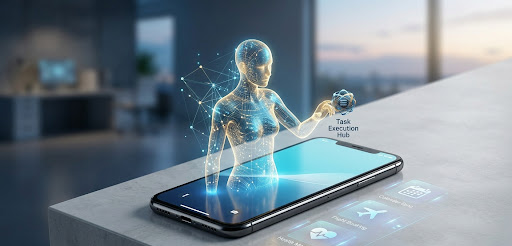
This shift from “Large Language Models” (LLMs) to “Large Action Models” (LAMs) is the science that is currently redefining the US economy.
2. The Tech Stack: How 2026 Changed the Game
The reason we are seeing this explosion now is due to three major scientific breakthroughs that matured this year:
- On-Device Neural Processing: Thanks to the latest NPU (Neural Processing Unit) chips in 2026 smartphones, AI doesn’t need to “call home” to a server for every thought. It happens locally, making it faster and more private.
- Multimodal Fluidity: AI can now “see” your screen and “hear” your tone. If you look stressed while reading an email, your agent can suggest drafting a polite boundary-setting response automatically.
- The Interoperability Standard: Major tech giants (Apple, Google, Microsoft) finally agreed on a shared protocol that allows AI agents to “talk” to different apps seamlessly.

3. Impact on the US Workforce: A New “Theory” of Productivity
There has been a lot of fear regarding AI taking jobs. However, the data coming out of US tech hubs in early 2026 suggests a different trend: Augmentation over Replacement.
In fields like Data Analysis and Digital Marketing, the “grunt work” (sorting spreadsheets, SEO keyword tagging, basic coding) is now 90% handled by agents. This leaves the human “Strategist” to focus on the “Theory”—the creative spark that AI still struggles to replicate.
TheDailyTheory Insight: We are moving toward a “1-Person Company” model. With a fleet of AI agents, a single entrepreneur in a garage in Seattle can now operate at the scale that previously required a staff of ten.
4. The Science of Digital Trust: Can We Trust the “Agents”?
As these systems become more autonomous, a scientific and ethical question arises: Alignment.
If you tell your AI agent to “Save me money on my monthly bills,” and it decides to cancel your gym membership because you haven’t gone in three weeks—did it do a good job, or did it overstep?
The University of Stanford’s 2026 AI Ethics Report highlights that the biggest challenge isn’t the AI’s intelligence, but its “Contextual Wisdom.” Understanding that a human might want to keep a gym membership despite not using it is a level of nuance that developers are still perfecting.
5. Consumer Tech: The Hardware Shift
We are seeing a decline in traditional smartphone sales in the USA for the first time in a decade. Why? Because Wearables are catching up.
- AI Glasses: Brands are launching sleeker, non-bulky glasses that act as the “eyes” for your agent.
- Neural Pins: Small devices that clip onto your clothing, focusing entirely on voice and gesture-based AI interaction.
The theory here is that we are moving toward “Invisible Computing.” You won’t look at a screen; you will just live your life, and the tech will assist you in the background.
6. Security in the Age of Autonomy
With great power comes great risk. In 2026, “Identity Theft” has evolved into “Agent Hijacking.” If a hacker gains access to your personal AI agent, they don’t just have your password; they have your Digital Proxy.
US cybersecurity firms are now pivoting toward Biometric Behavioral Verification. This means your AI agent constantly checks if the “vibe” of the commands it receives matches your unique personality and usage patterns.
7. Conclusion: The Human Element
At the end of the day, TheDailyTheory.com believes that while technology evolves exponentially, human nature changes slowly. We still crave connection, creativity, and purpose.
The AI Agent revolution isn’t about making us lazy; it’s about removing the “digital friction” that consumes our days. Imagine a world where you spend zero minutes on “admin tasks” and 100% of your time on what you actually love. That is the promise of 2026.

